
Free spelling test maker, kindergarten to 2nd grade
Spelling test maker: type the words, print the test on handwriting lines
Type this week's spelling words and print the test. Your kid gets a numbered spelling test on three-line handwriting paper, with the lines sized for kindergarten, 1st or 2nd grade. You get a read-aloud list of the same words, with a box to tick for each one. Most weeks that's a page each, and the maker shows you every page before you print. It's free, it works on a phone, and it prints on US Letter or A4.
Make this week's test
Type the words, look over the sheets, print. The maker keeps your last test on this device, so next week starts where you left off.
The maker needs scripts to fill in your words, and they're off in this browser.
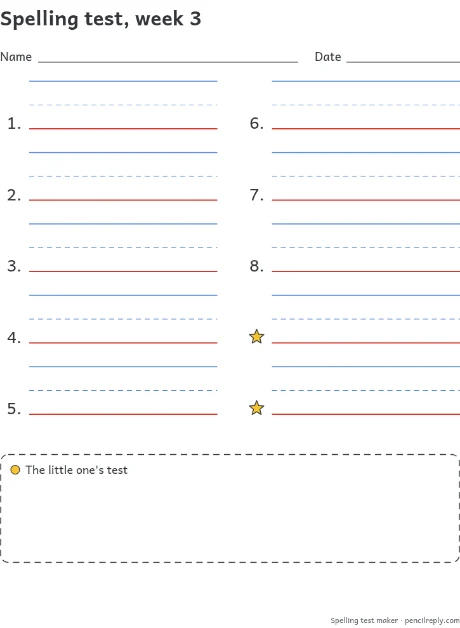
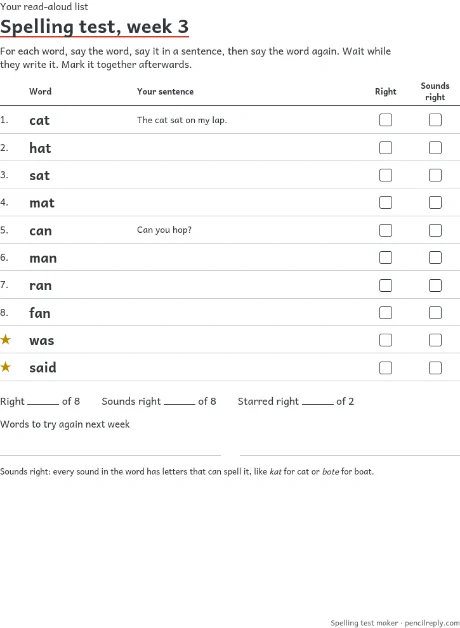
The sheets here are a blank 10-word test on 1st grade lines and its read-aloud list. Print this page and you get both. Or pick a blank test in another size.
What prints: their test, then your list.
Your read-aloud list
Spelling test
For each word, say the word, say it in a sentence, then say the word again. Wait while they write it. Mark it together afterwards.
| Number | Word | Your sentence | Right | Sounds right |
|---|---|---|---|---|
| 1. | ||||
| 2. | ||||
| 3. | ||||
| 4. | ||||
| 5. | ||||
| 6. | ||||
| 7. | ||||
| 8. | ||||
| 9. | ||||
| 10. |
Right of 10
Sounds right of 10
Words to try again next week
Right: spelled the way your list has it. Sounds right: every sound has letters that can spell it, like kat for cat or bote for boat. A word that's Right sounds right too, so tick both. Writing their for there sounds right but isn't Right. The totals count the numbered words; starred words have their own line. Any word that isn't Right goes under Words to try again.
Blank spelling test templates to print
No words yet, or just want a blank sheet? Print one of these. Each one opens two sheets ready to print: a numbered test on handwriting lines, then a blank read-aloud list to write your words on. Two pages, US Letter or A4. To keep one as a PDF, print it and choose Save as PDF.
How to give a spelling test at home
Sit beside your kid with your list and their sheet. For each word, say the word, say it in a sentence, then say the word again. They write it on the next numbered line. Then you wait, and keep your face still, which is harder than it sounds. When the last word is done, mark it together: you say each word and spell it out loud, and they check their own lines.
The sentence tells them which word you mean (there or their, to or two), and saying the word once more gives them one last listen before they write. Make the sentences up on the spot if you like. It's the fun part of your job, and a silly one about the dog keeps everybody awake.
Sentences on the test work the same way. Build them from words and sounds they've already practised, and read the whole sentence twice, slowly. They write it on the lines under its number, and you read it once more at the end so they can check for missing words.

How many spelling words a week in kindergarten, 1st and 2nd grade?
Fewer than you'd think. A short list that sticks beats a long one that's crammed on Thursday night. Where you land depends on your kid. A few places to start:
- When spelling isn't clicking, go small: one pattern, six to ten words, and the words they missed coming back in a sentence the next day.
- For a kid who is just starting to spell, four to six short words made of sounds they already know is a whole test (more on that below).
- Our own plan, The Spelling Year, uses 8 words a week for kindergarten to 1st grade, 6 more for 2nd grade and older kids catching up, and just 4 in a week when it isn't clicking.
On one sheet, the maker fits up to 14 words on kindergarten lines, 16 on 1st grade lines and 22 on 2nd grade lines, when each word is short enough to share a line. Longer words get a whole line each. Past one sheet it carries on to a second page and tells you so.
Which line size for kindergarten, 1st and 2nd grade?
Handwriting paper is sized by its tall letters: the distance from the solid top line down to the red baseline. Two well-known handwriting programmes, Zaner-Bloser and D'Nealian, size them like this:
| Grade | Tall letters | Baseline to next baseline |
|---|---|---|
| Kindergarten | 3/4 inch (both) | 1 1/8 inch |
| 1st grade | 5/8 inch (Zaner-Bloser), 1/2 inch (D'Nealian) | 15/16 inch, 3/4 inch |
| 2nd grade | 1/2 inch (both) | 3/4 inch |
The maker uses those three sizes, with the room for tails below each baseline that Zaner-Bloser paper has. Go by your kid's hand more than the grade, though. If their letters float above the baseline or squash under the dashed line, try a size bigger. Older kids who are catching up often still like 1st grade lines.
Should kindergartners have spelling tests?
We'd give them the test and skip the score. At this age a spelling test is really dictation: you say a word, they sound it out and write it, and you check it together straight away. What you're watching for is whether they hear every sound and find a letter for it, and that shows up fine without a number at the top.
So for a kid who is just starting to spell, at five or at eight, keep it small and friendly: four to six short words made of sounds you've already taught, said slowly, checked together straight after. Let them say the sounds out loud while they write. The box that matters most at this stage is Sounds right.
And if there's a preschooler at the table who wants a test too (there usually is), tick the little one's box. They get their own space at the end of the test, on the same sheet when there's room, to scribble a test of their own, and the real test gets finished in peace. Mostly.
How to mark a spelling test kindly: right, and sounds right
Your list has two boxes for each word. Tick Right when it's spelled the way your list has it. Tick Sounds right when every sound in the word has letters that can spell it, like kat for cat or bote for boat. A word that's Right sounds right too, so it gets both ticks. A real word that sounds the same but is the wrong one, like their for there, sounds right but isn't Right. Sounds right means they heard every sound and picked a possible way to write each one. That's a good sign, and the spelling still has to be learned.
Those Sounds right tries count for a lot. In a study of 171 kindergartners, the ones whose own spellings caught more of a word's sounds went on to read and spell better a year later, in 1st grade (Ouellette and Sénéchal, Developmental Psychology, 2017). The study didn't look at marking. That part is our own advice: tick a good try as a good try.
Count both boxes for the numbered words, and the starred words on their own line. Any word that isn't Right goes under Words to try again. A week with lots of Sounds right and not many Right tells you the sounds are there and the spellings are still coming. A word that isn't even Sounds right is the one to sit down with.
What to do with the words they missed
A kid can read said every day and still write sed on Friday. When they read it, the word is right there on the page to recognize. To spell it, they have to pull every letter out of thin air. So practice the misses first, rather than the whole list again. Spend most of the time on the hard ones, and let an easy word come back now and then so it sticks.
Write them under Words to try again on your list. Next week, type up to two of them into Words to try again in the maker. They print on starred lines at the end of the test, after the numbered words. Two is plenty, and it keeps the test short.
Printing it at the right size
Each sheet is 7.25 by 9.9 inches, so it fits inside half-inch margins on both US Letter and A4. Pick your paper in the maker and print at Actual size (or 100%), never Fit or Shrink, or the lines come out smaller than the size you chose. On a phone, use Share and then Print, or save it as a PDF and print it later.
On a black and white printer the blue and red lines come out grey. The dashed middle line stays dashed, so the three lines still read the way they should.
Nothing you type is sent anywhere. The maker runs in your browser and keeps your last test on this device only. A link you copy leaves out the Kid's name box and carries everything else, title included, so keep names out of the title of a test you'll share.
Want the words planned too?
The maker prints any list you give it. If you'd rather have the list, the sentences and the five short days around them done for you, that's The Spelling Year: 36 weeks of spelling for kindergarten to 2nd grade, one pattern a week, a script for every day and a Friday dictation test with a marking guide.
Week 1 is free to print, all nine pages, with nothing to sign up for.
More free things like this one are on Free pages.