
Homeschool spelling, kindergarten to 2nd grade, and older kids who are catching up
The Spelling Year 36 weeks of homeschool spelling, kindergarten to 2nd grade
You teach it straight from the page. One pattern a week, a script for every day, and a Friday test that's the next chapter of a family treasure hunt.
$29 once for the whole year: all 36 weeks and the start pack. Or one term for $12, with the start pack.
It isn't on sale yet. Week 1 is free to print right now, all nine pages, and our free series by email will say when the year opens.
PDFs you print at home on US Letter or A4. Black and white printing works.
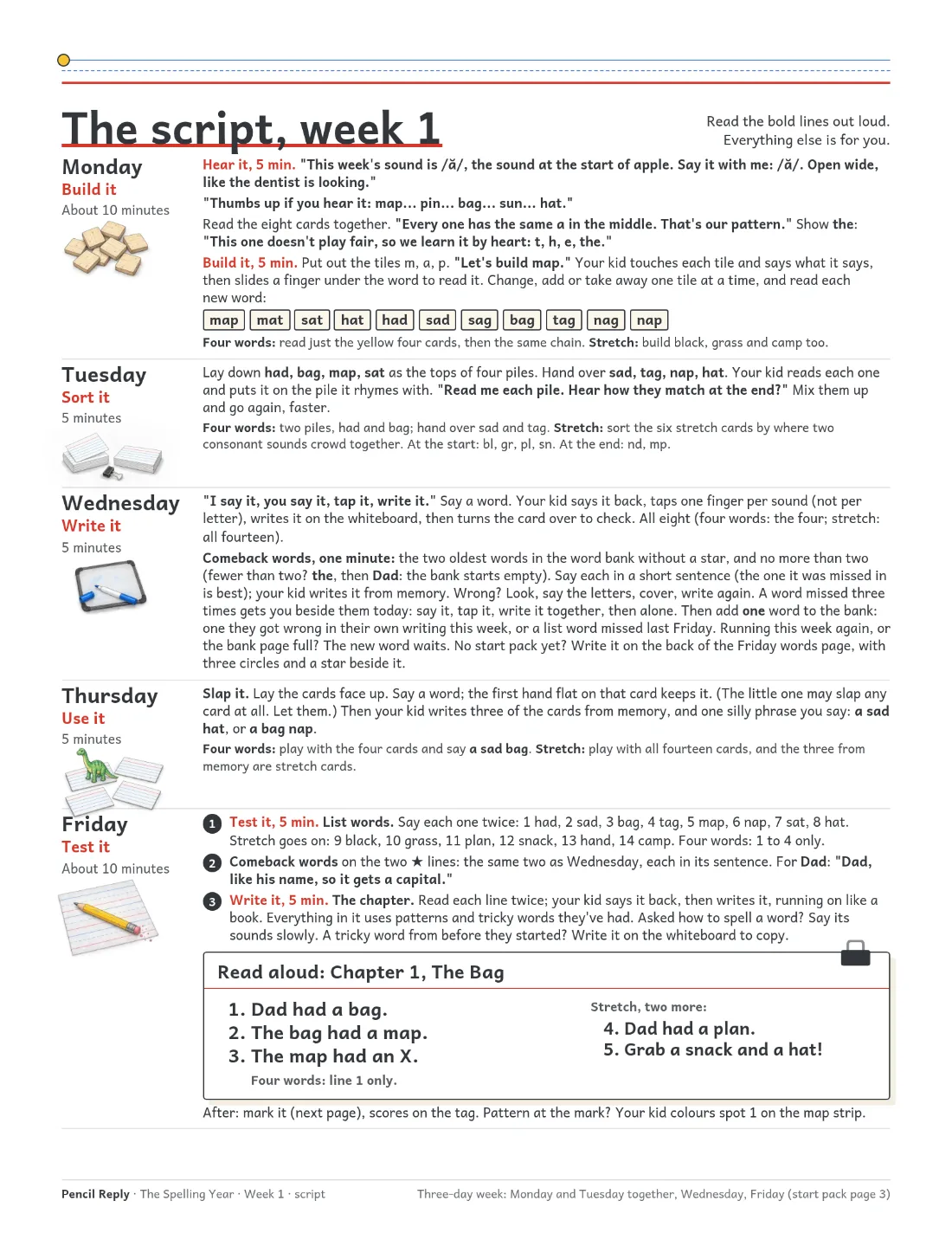
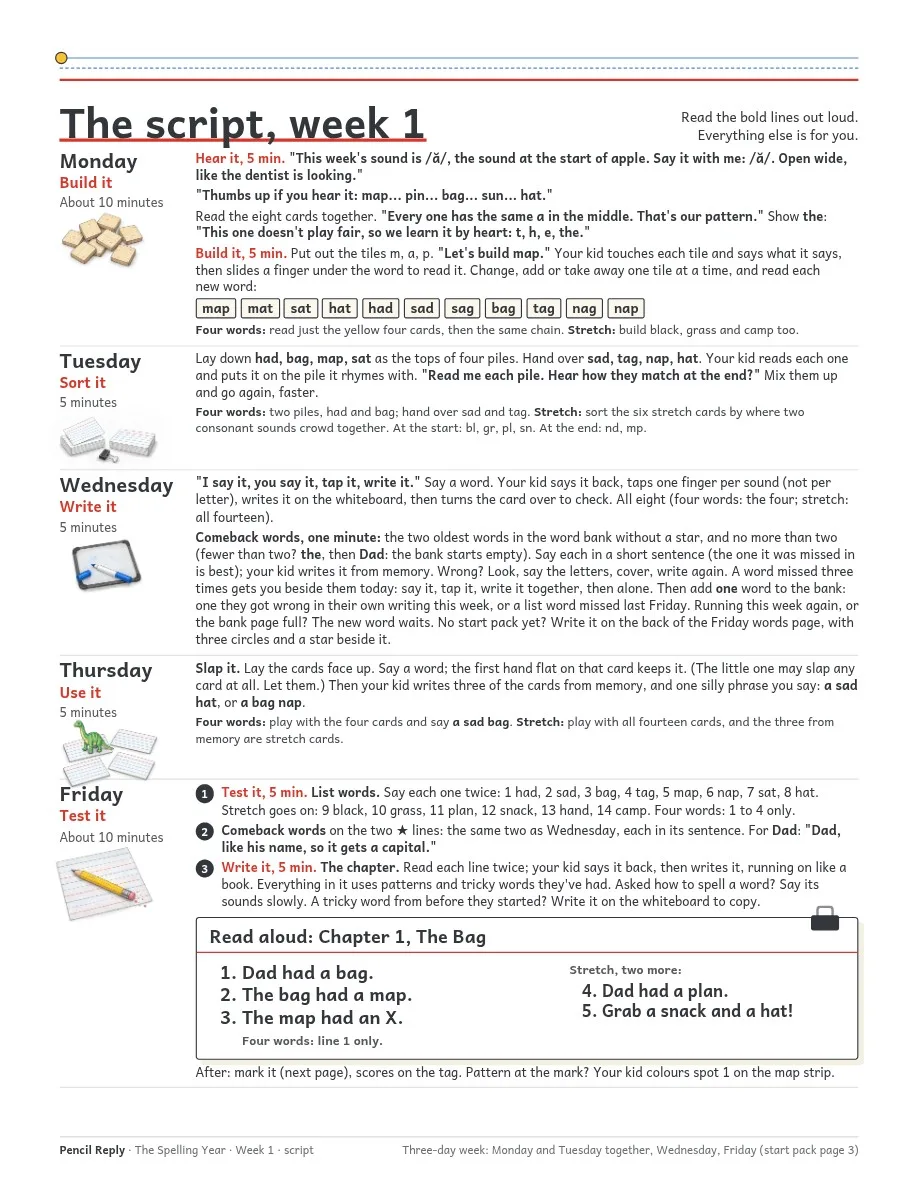
2 · The script. Yours. The bold lines are what you say out loud, Monday to Friday.
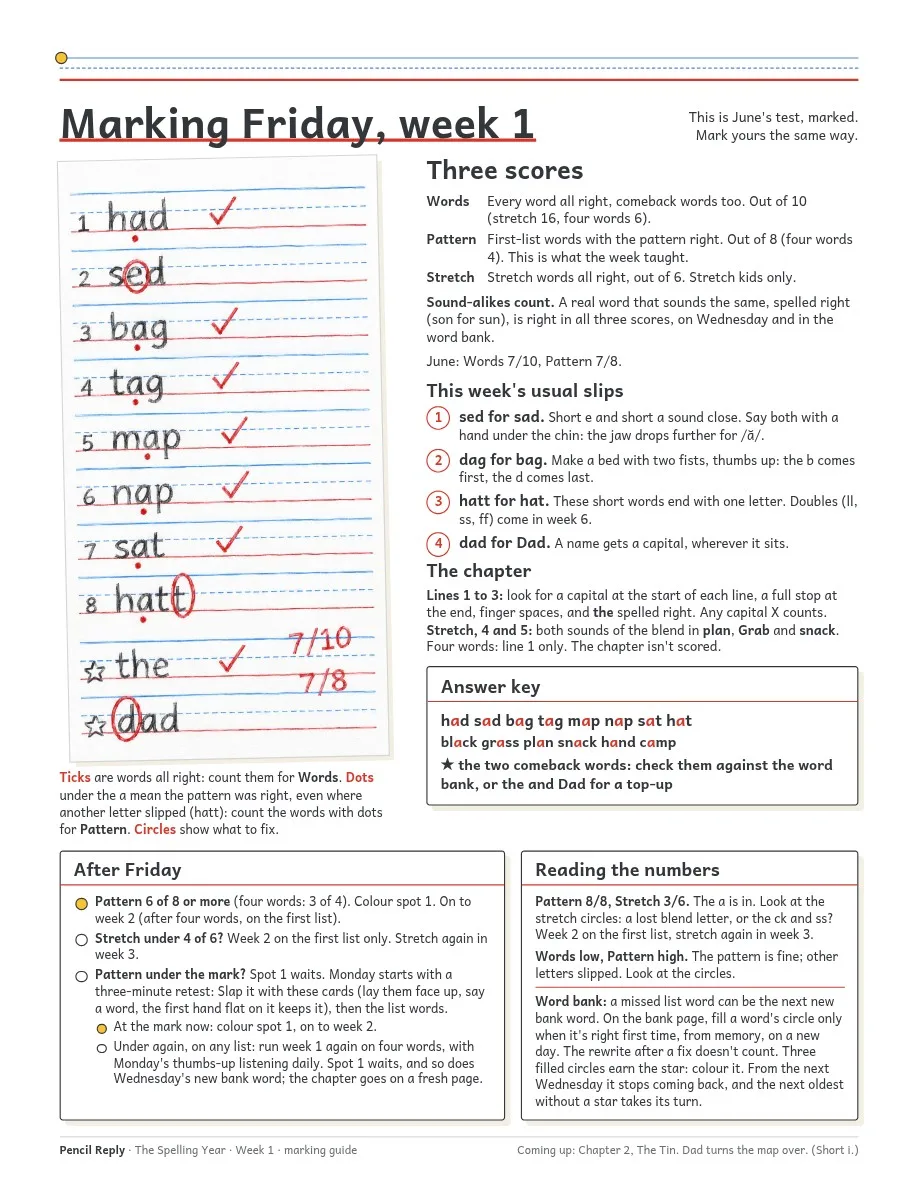
3 · Marking Friday. Yours. June's marked test, the three scores, the usual slips and the answer key.
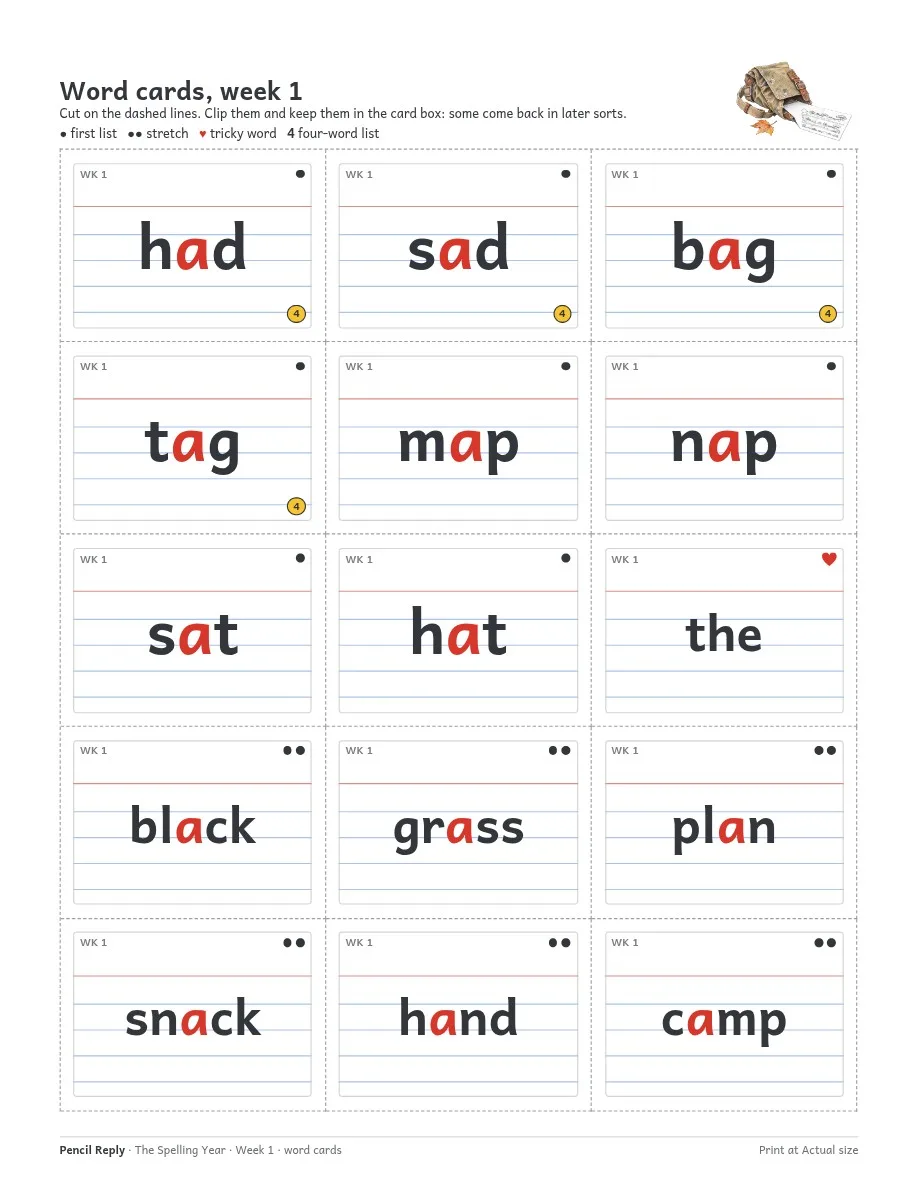
4 · Word cards. Your kid's. 15 cards to cut out.
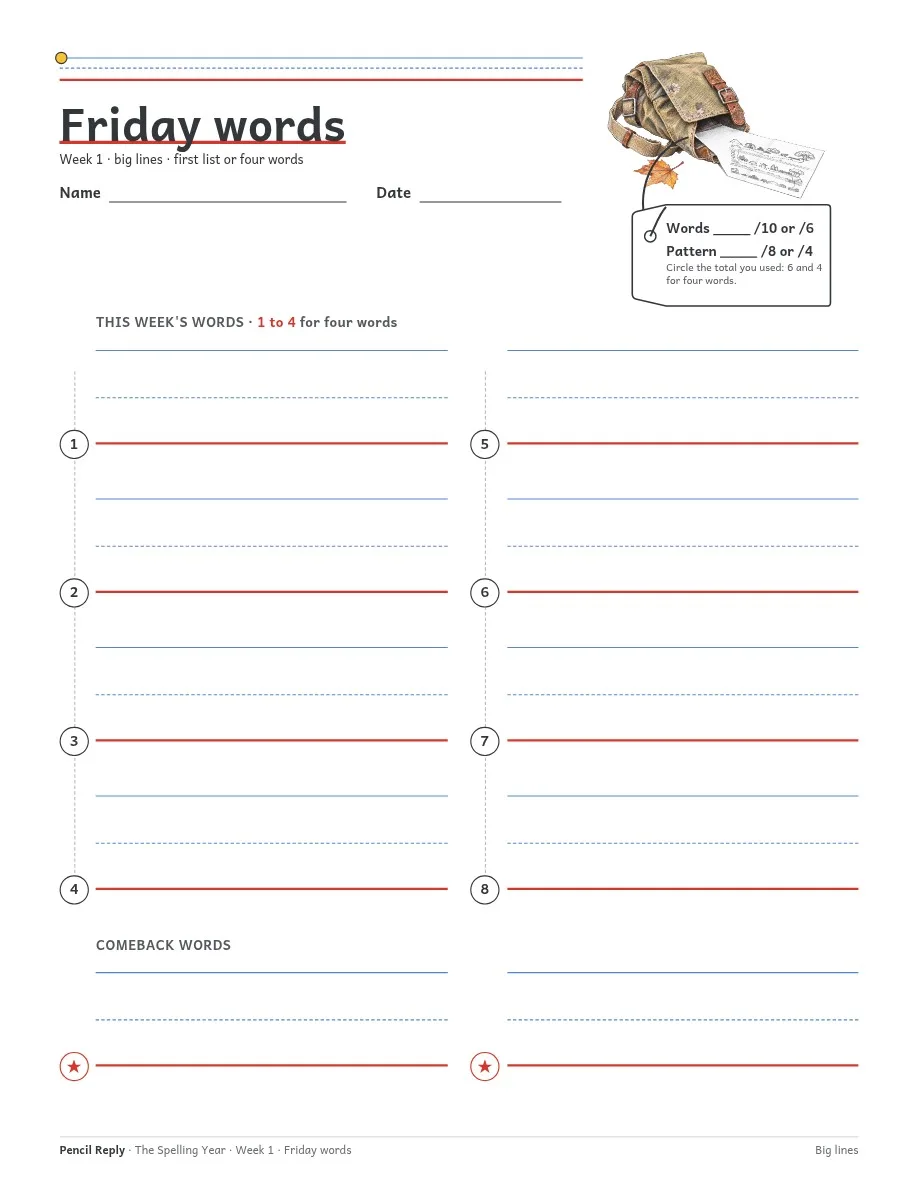
5 · Friday words, big lines. The younger one's Friday test, on the first list.
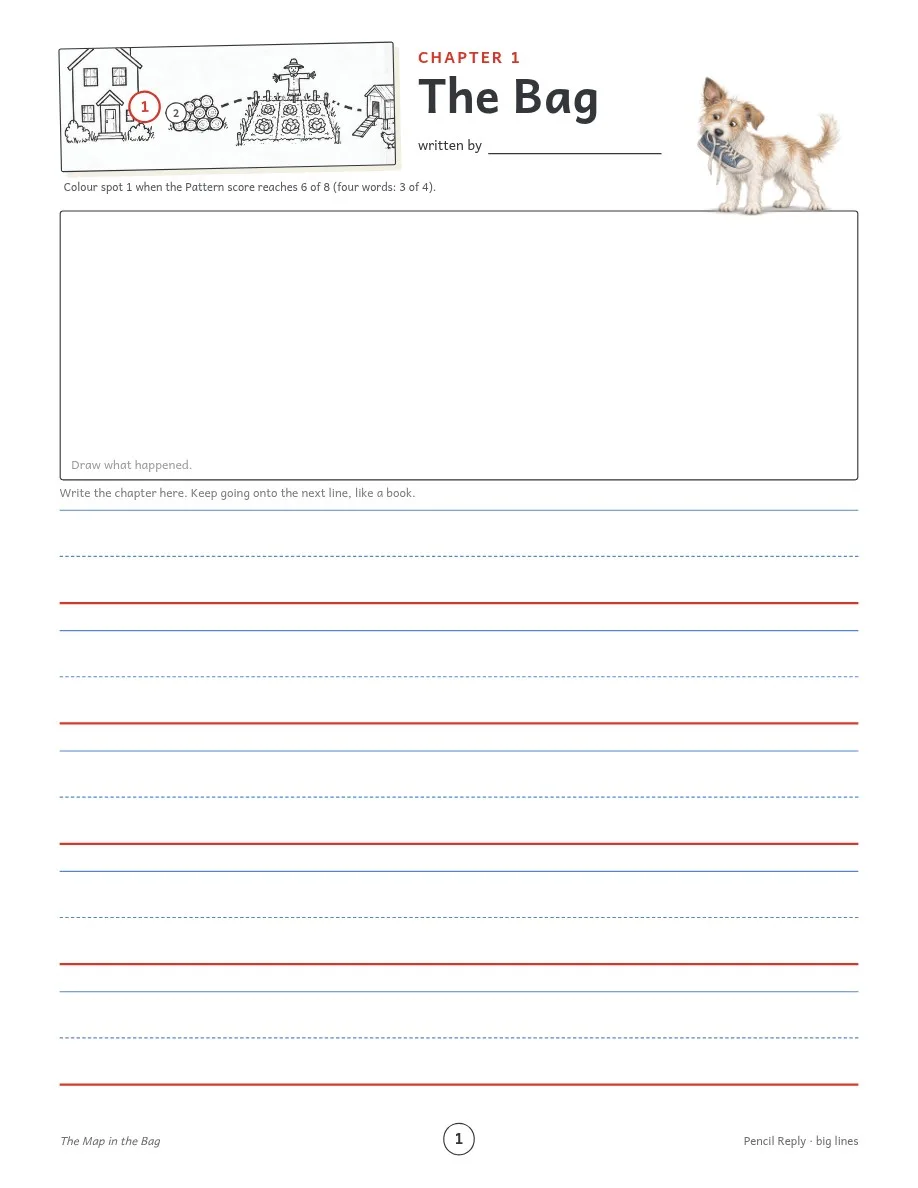
6 · Chapter page, big lines. The younger one writes Chapter 1 here.
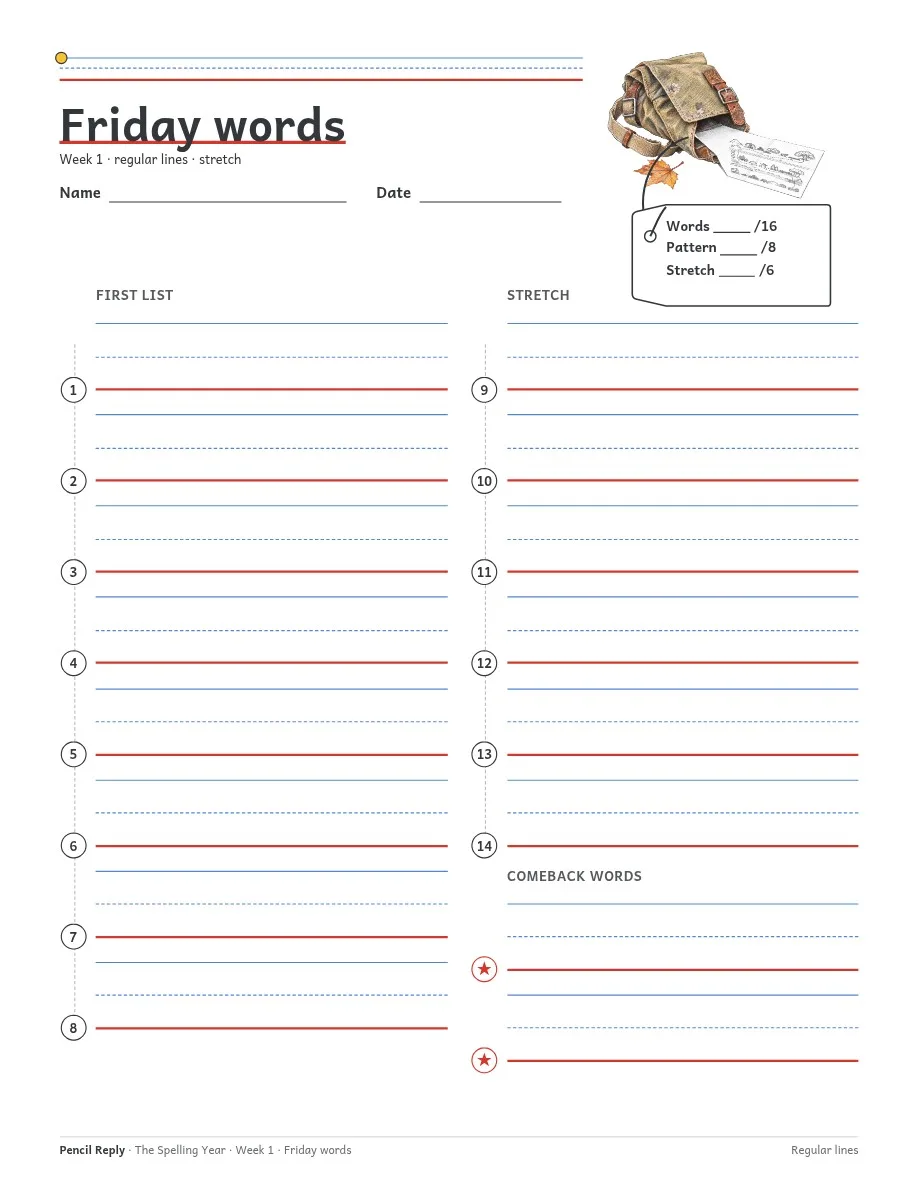
7 · Friday words, regular lines. The older one's test, for the stretch list.
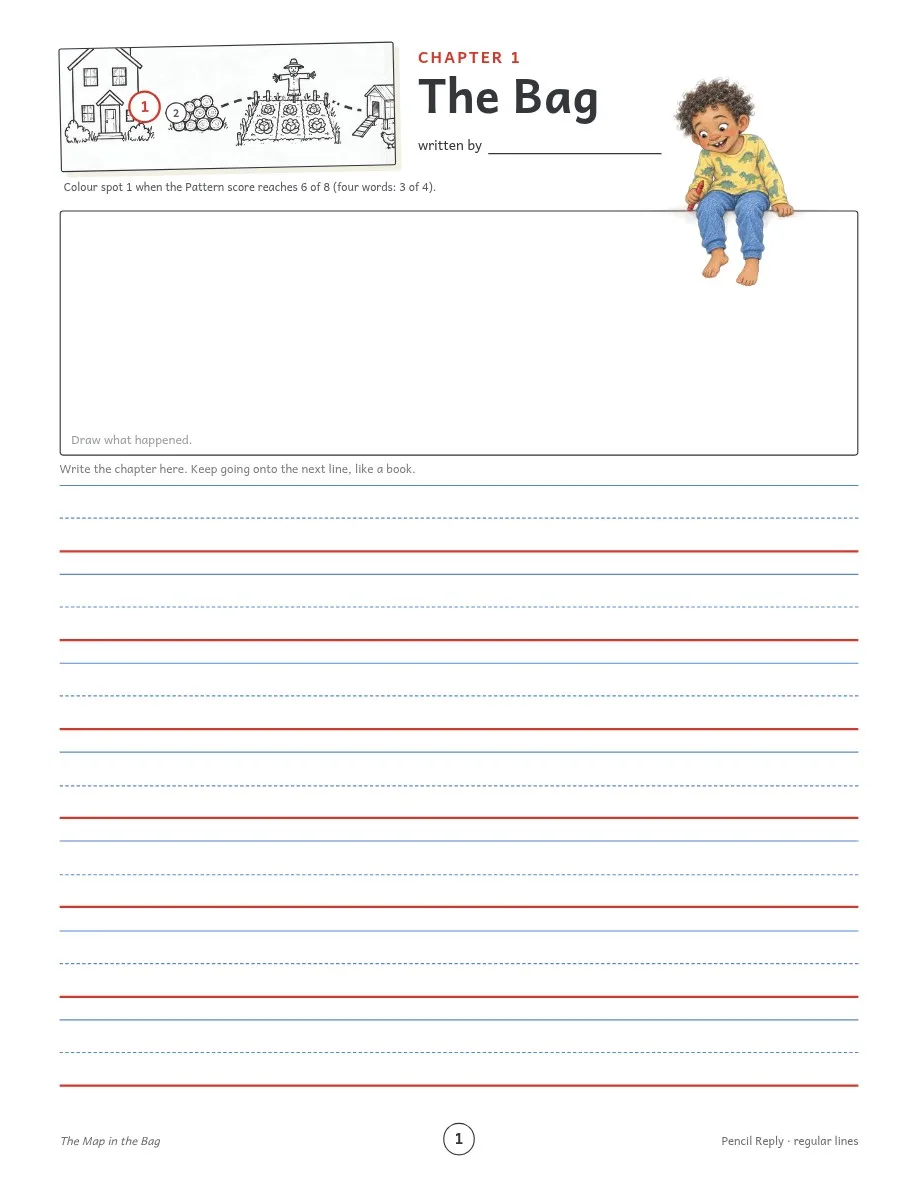
8 · Chapter page, regular lines. The older one's chapter page.
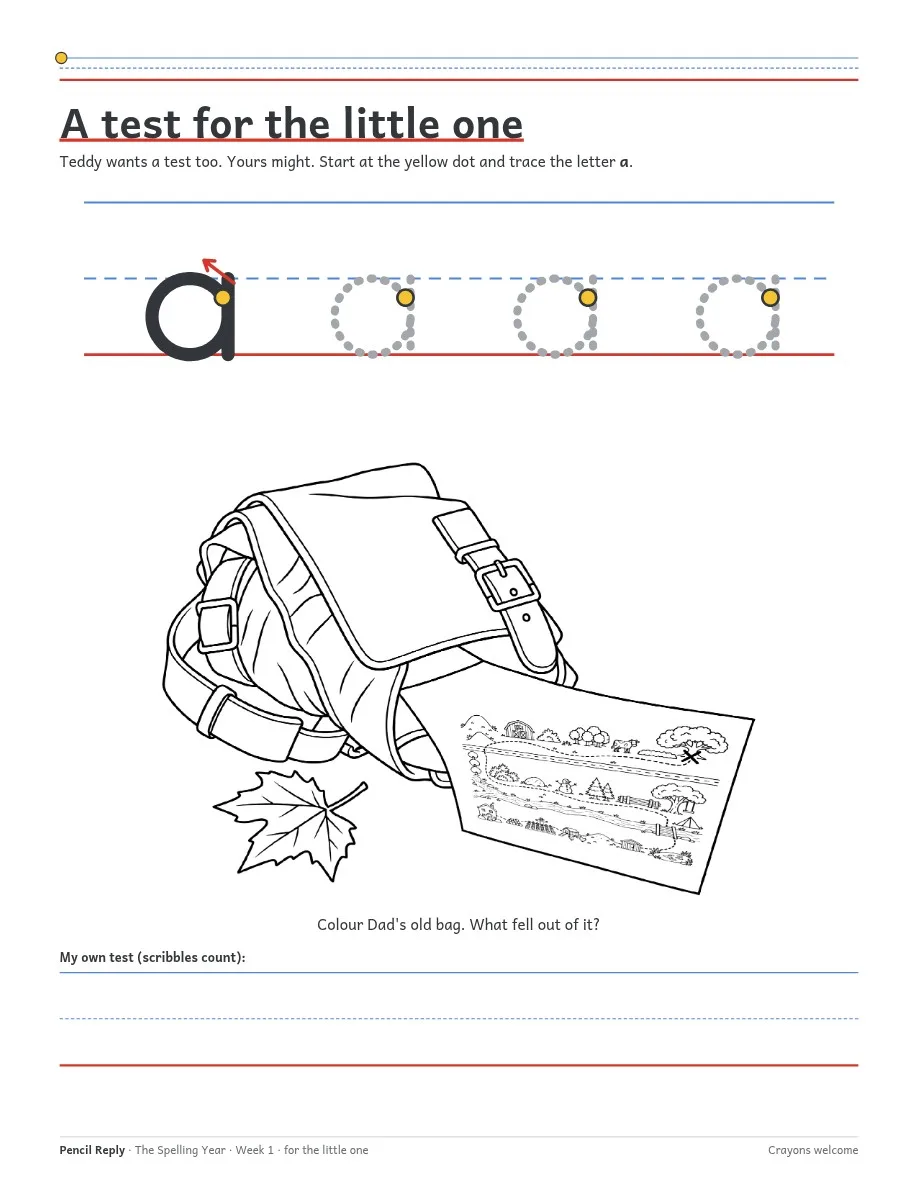
9 · A test for the little one. For the kid who wants a test too.
Paused, so the table waits where it is. Press Play and it carries on.
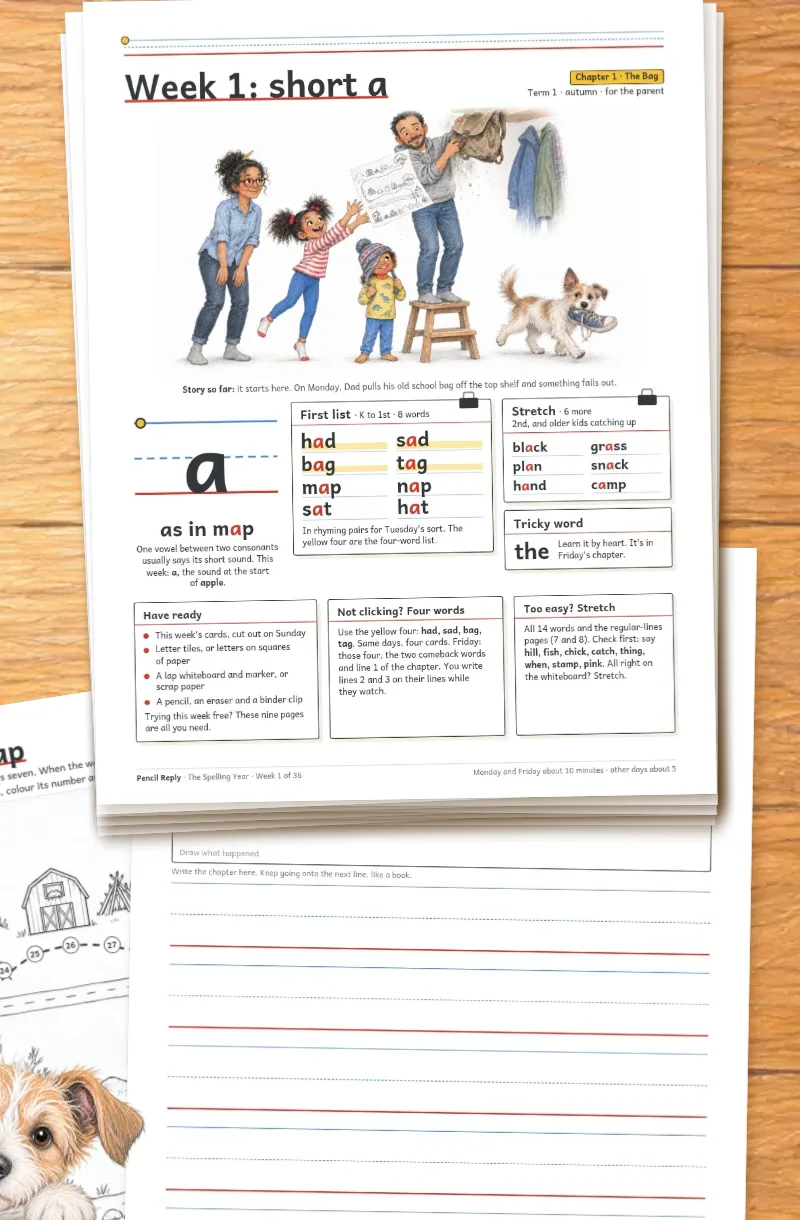
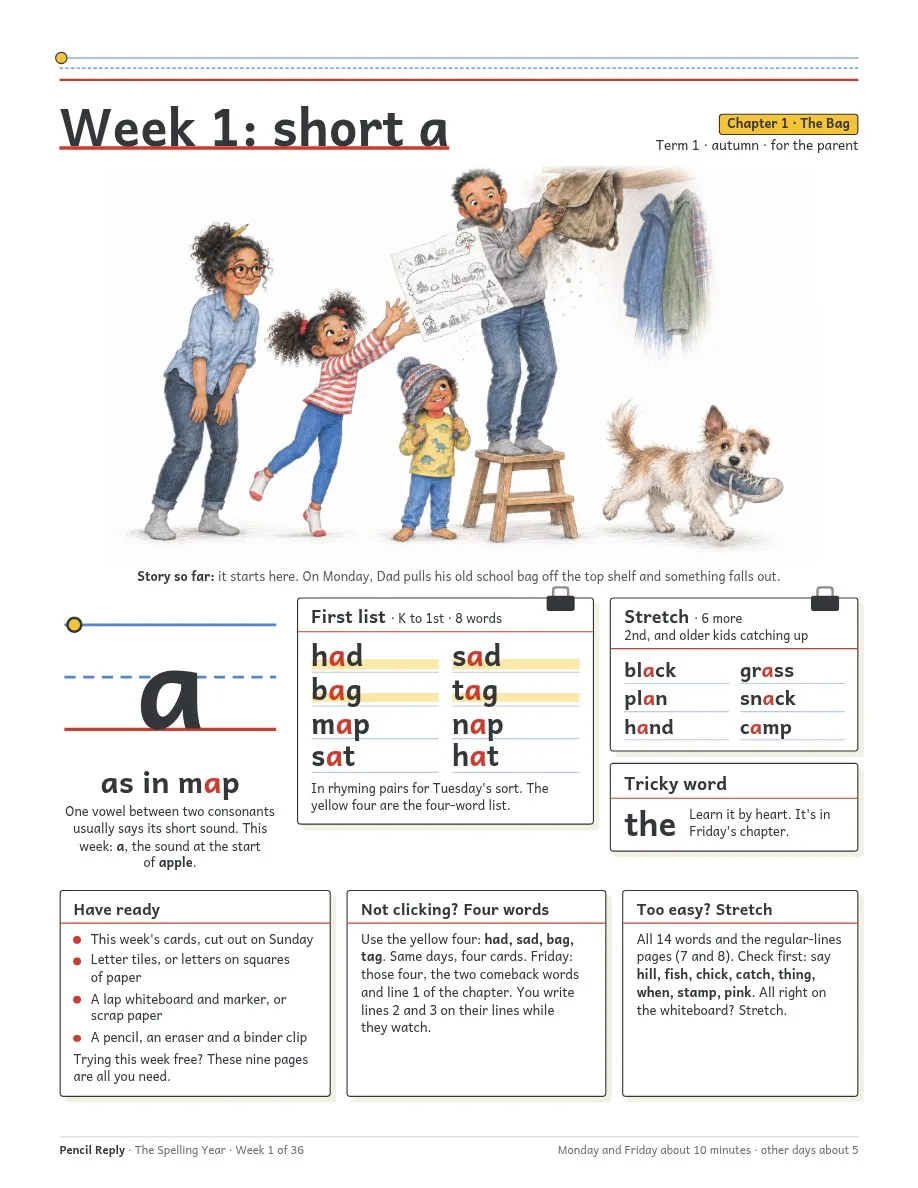
Page 1 of 9 · Our week. Yours. The week's story scene, the short a pattern, both word lists, the tricky word, and what to do if it isn't clicking or is too easy.
Week 1 is free. Try a whole week at your table.
All nine pages, the same ones as in the year: your page, the script, the marking guide, the cards, Friday words and chapter pages on both line sizes, and the little one's page.
It runs without the start pack. Spot 1 is on the chapter page's own map strip, the scores go on the Friday page's tag, and your kid's first word bank word goes on the back of the Friday page, with three circles and a star. A circle is filled only when the word is right first time, from memory, on a new day. Three earn the star, and from the next Wednesday it stops coming back.
It ends on Chapter 1's open question. What's at the X? The other 35 chapters come with the year.
Download the complete Week 1, free
PDF, 9 US Letter pages, 4 MB. Nothing to sign up for. Print it at Actual size on US Letter, or with Fit on A4.
Everything in the year
A start pack and 36 weeks, as PDFs. Every week is nine US Letter pages in the same order, so by week 3 you know where everything is.
Start pack (12 pages)
PDF, 12 US Letter pages, prints on A4 with Fit. Comes with the year and with each term.
- Cover. Friday at the kitchen table with Sam's old map, the hen's bite in its right edge, and Dad's red-handled trowel.
- Before week 1. A ready-to-start check, a once-only checklist (print, placement check, letter tiles, a binder with the book cover, a folder for the bank, map and record, a box for cards, pin up the map), ten minutes every Sunday, what to do when life happens (a missed week, a sick Friday) and the five materials of the week.
- How a week goes. Monday to Friday with what you need each day. Monday and Friday take about ten minutes, in two five-minute parts you can do back to back or apart. Tuesday to Thursday take about five. Also the story, what to print each Sunday, the three ways through a week (first list, stretch, four words), a three-day week, keeping the book together, and what happens after Friday. A family doing Term 1 or 2 alone finds the book pausing at chapter 12 or 24 until the next term.
- Where to start. A 23-word placement check in four groups, about fifteen minutes. It points to week 1, 6, 14 or 21 and to the first or stretch list. A sound-alike spelled right counts as right. Plus what to do when you start after week 1.
- The year at a glance. All 36 weeks with a picture, pattern and chapter title, by term, and the 36 tricky words.
- Sam's map. One path with 36 numbered spots. A spot is coloured when that week's Pattern score reaches 6 of 8 (3 of 4 on a four-word week), the same mark the marking guide uses.
- My word bank. One page a term, a fresh one each term with the words that have no star yet copied over. 18 ruled rows, each with three circles and a star, for words from your kid's own writing. One new word each Wednesday, none in a week you run again or once all 18 rows are full. The two oldest without a star are the only bank words practised, on Wednesday and on Friday's test, and a sound-alike spelled right counts. Three filled circles earn the star, and from the next Wednesday that word stops coming back. A word missed three times gets you beside them for it on Wednesday: say it, tap it, write it together, then alone.
- Our spelling year. A record sheet for the portfolio with a row for each of the 36 weeks (date, list, Words, Pattern and Stretch scores), filled the day the spot is coloured, plus work-sample boxes.
- Letter tiles. 72 tiles to cut: vowels on yellow, spare common consonants, 5 blanks.
- Letter teams. 32 teams as tiles, two of each, plus blanks: consonant teams (sh, ch, th, wh, ck, tch, ng, nk, qu), vowel teams (ee, ea, ai, ay, oa, ow, igh, oo, ou, oi, oy, aw, au, all, ar, or, er, ir, ur) and endings (ed, ing, es, le). A What each team says card above the tiles gives every team the sound it makes in the year's pattern words, with an example word, and a second or third sound where those words use one, like ow in snow and cow or ed in jumped, filled and landed.
- Book cover for your kid's chapters: The Map in the Bag, written by.
- The end. The last page of their book: the family opening the tin, the dog asleep in Dad's old bag with Sam's map under his chin, a frame to draw the writer and an About the writer card.
Term 1, autumn: weeks 1 to 12
12 PDFs, 9 US Letter pages each, the same layout every week. Also sold alone at $12, with the start pack.
Every week, in this order:
- Our week, for you. The week's story scene, the pattern, a first list of 8 words for the younger kid with the four-word list marked in yellow, a stretch list of 6 more for a 2nd grader or an older kid who is catching up, the tricky word, what to have ready, and what to do when it isn't clicking (four words) or is too easy (stretch).
- The script. Bold lines to read aloud on Monday, with a one-tile-at-a-time word chain. A five-minute activity for Tuesday to Thursday (sort, write, a card game), each with its four-word and stretch version. Wednesday's one-minute comeback words (the two oldest bank words, never more) and its one new bank word. Friday's order with the chapter to read aloud: 3 numbered lines, 2 more for stretch, line 1 only for four words. Monday and Friday take about 10 minutes each, in two 5-minute parts, and Tuesday to Thursday about 5. The footer gives a three-day week: Monday and Tuesday together, Wednesday, Friday.
- Marking guide. June's marked pencil test, the three scores (Words, Pattern, Stretch), a note that a sound-alike spelled right counts in all three scores, on Wednesday and in the word bank, the week's four usual slips with a fix for each, what to check in the chapter, the answer key, and what to do after Friday. Pattern at the mark: colour the spot. Under it: a three-minute Monday retest, a round of Slap it with the week's cards (the guide explains the game) and then the list words. Still under: the week runs again on four words, and the map spot and Wednesday's new bank word wait. Then how to read the numbers.
- 15 word cards to cut out: 8 first list, 6 stretch and the tricky word.
- Friday words on big lines (7/8 in rows): 8 numbered lines and 2 starred comeback lines, with a score tag on the week's story object.
- Chapter page on big lines. A strip of Sam's map with this week's spot and the next, and nearby earlier spots where they fit, with the reminder "Colour spot N when the Pattern score reaches 6 of 8 (four words: 3 of 4)". Then the chapter title, written by, a drawing frame and 5 rows that run on like a book.
- Friday words on regular lines (5/8 in rows) for stretch: 14 numbered lines and 2 starred comeback lines.
- Chapter page on regular lines, with the same map strip and reminder, 7 rows.
- A test for the little one. Trace a letter, colour the week's story object, scribble a test of their own.
Weeks: 1 short a (The Bag), 2 short i (The Tin), 3 short o (The Dog), 4 short u (The Mud), 5 short e (The Hen), 6 ll, ss, ff, zz (The Hill), 7 sh (The Shed), 8 ch, tch (The Latch), 9 th, wh (The Path), 10 ck (The Rock), 11 blends at the start (The Plank), 12 blends at the end (The Tent). Week 1 works on its own without the start pack.
Term 2, winter: weeks 13 to 24
12 PDFs, 9 US Letter pages each, the same layout and timing as Term 1. Also sold alone at $12, with the start pack.
Weeks: 13 ng, nk (The Ring), 14 a_e (The Gate), 15 i_e (The Sled), 16 o_e (The Bone), 17 u_e, e_e (June's Name), 18 -s, -es (Fox Tracks), 19 -ed (The Thaw), 20 -ing (The Fishing Rock), 21 ee, ea (Three Trees), 22 ai, ay (The Trail), 23 oa, ow (The Road), 24 igh, y (The Night Walk).
Some Tuesday sorts bring back cards from earlier weeks. Starting here, you print that week's page 4 or write the words on scraps, and start pack page 4 says so. The placement check says when Term 2 suits (a start at week 13, 14 or 21), each parent page opens with the story so far, and your kid's book begins at their first chapter. Week 24 ends the term with a note that the book rests at chapter 24 until Term 3.
Term 3, spring: weeks 25 to 36
12 PDFs, 9 US Letter pages each, the same layout and timing as Term 1. Also sold alone at $12, with the start pack.
Weeks: 25 y says e (Teddy's Name), 26 ar (The Barn), 27 or, ore (The Fort), 28 er, ir, ur (The Bird), 29 oo (The Woods), 30 ou, ow (The Cow), 31 oi, oy (The Coin), 32 aw, au, all (The Wall), 33 soft c, soft g (The Giant Tree), 34 doubling and drop the e (Digging), 35 two-syllable words (The Rusty Tin), 36 -le (Inside the Tin).
Chapter 36 ends the story and sends you to the book cover and The end page from the start pack, which go in front of and behind the chapter pages in the binder. The placement check says Term 3 suits a kid who gets all 23 words right, and their book begins at their first chapter.
Six real pages from the year
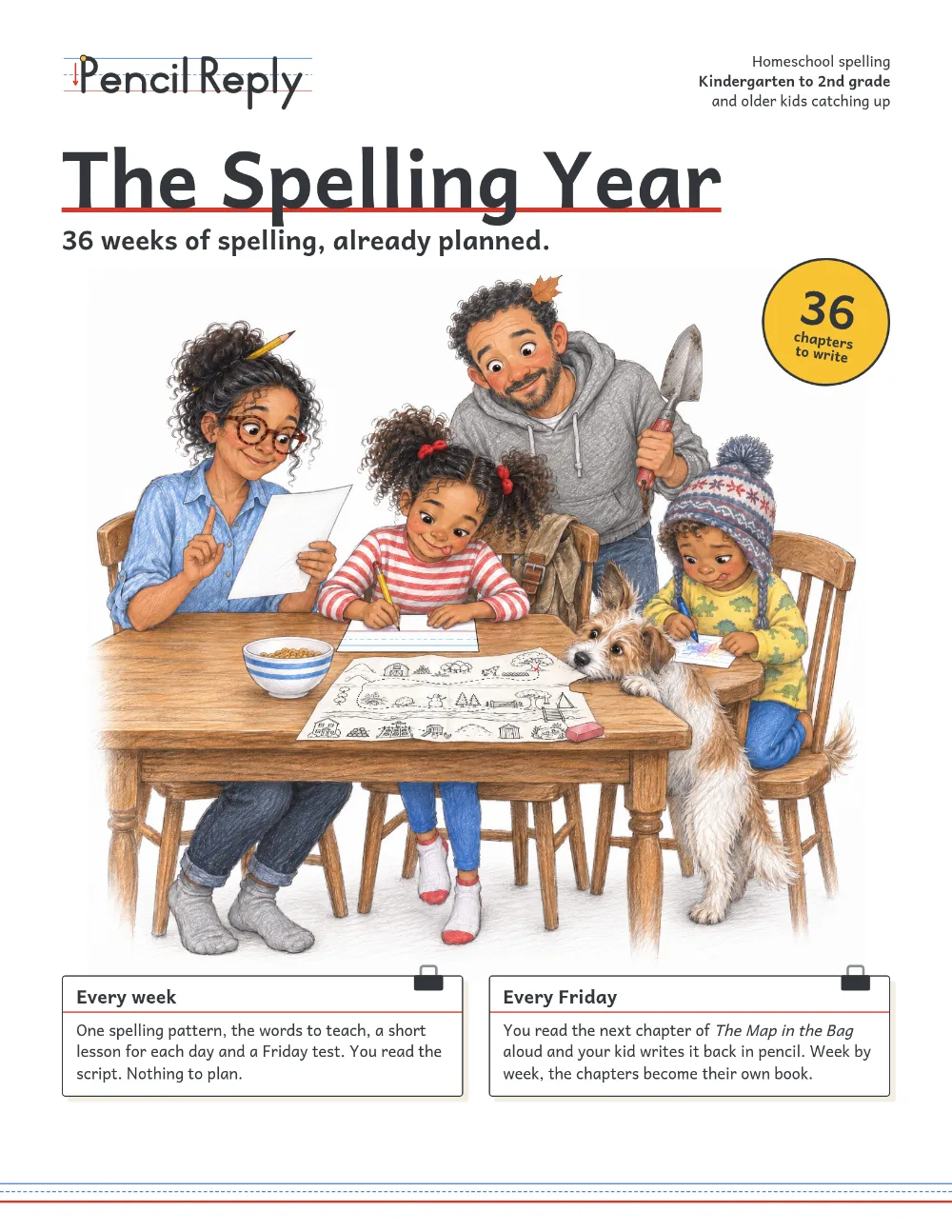
The start pack's cover. Everyone's there, including the dog. 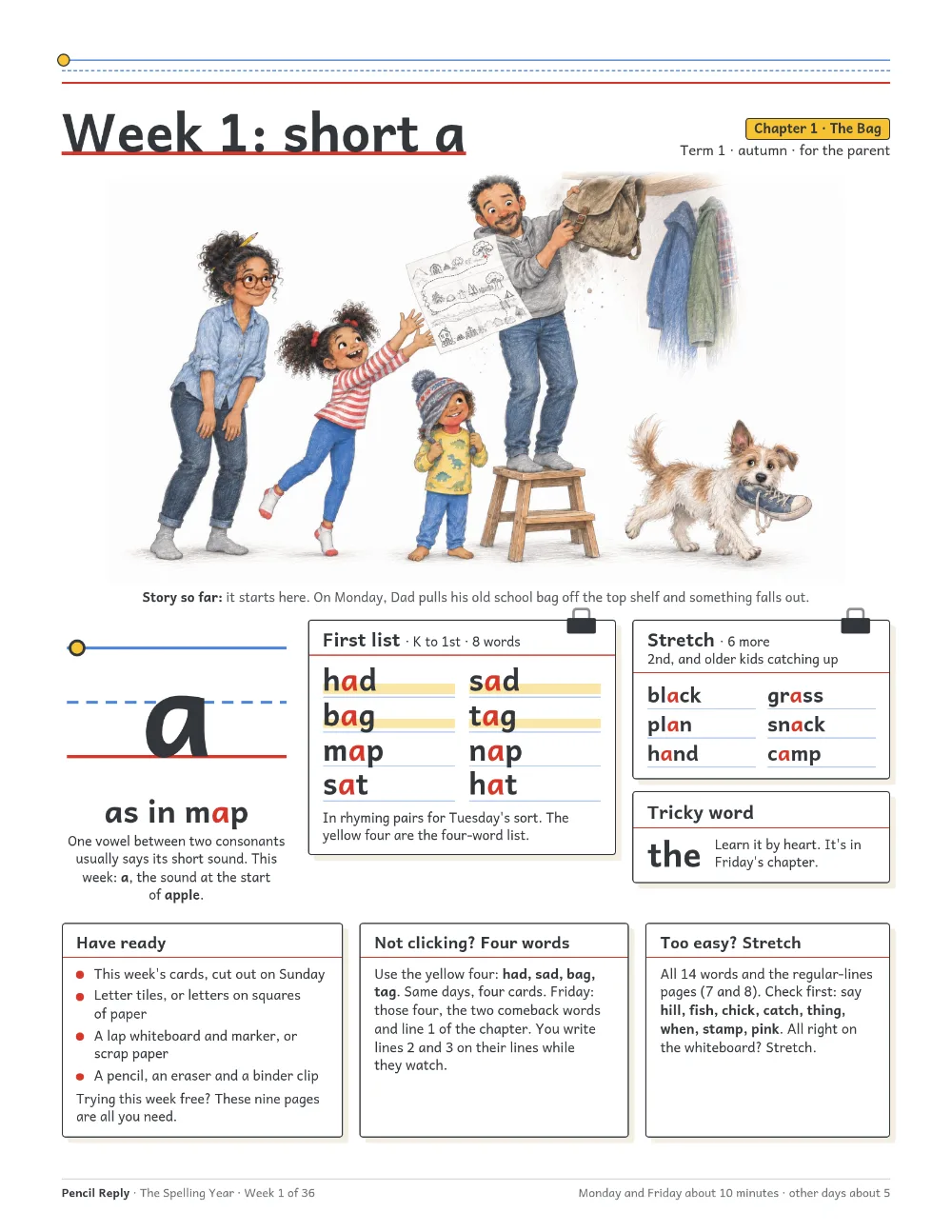
Week 1's page for you. The footer gives the time: Monday and Friday about 10 minutes, the other days about 5. 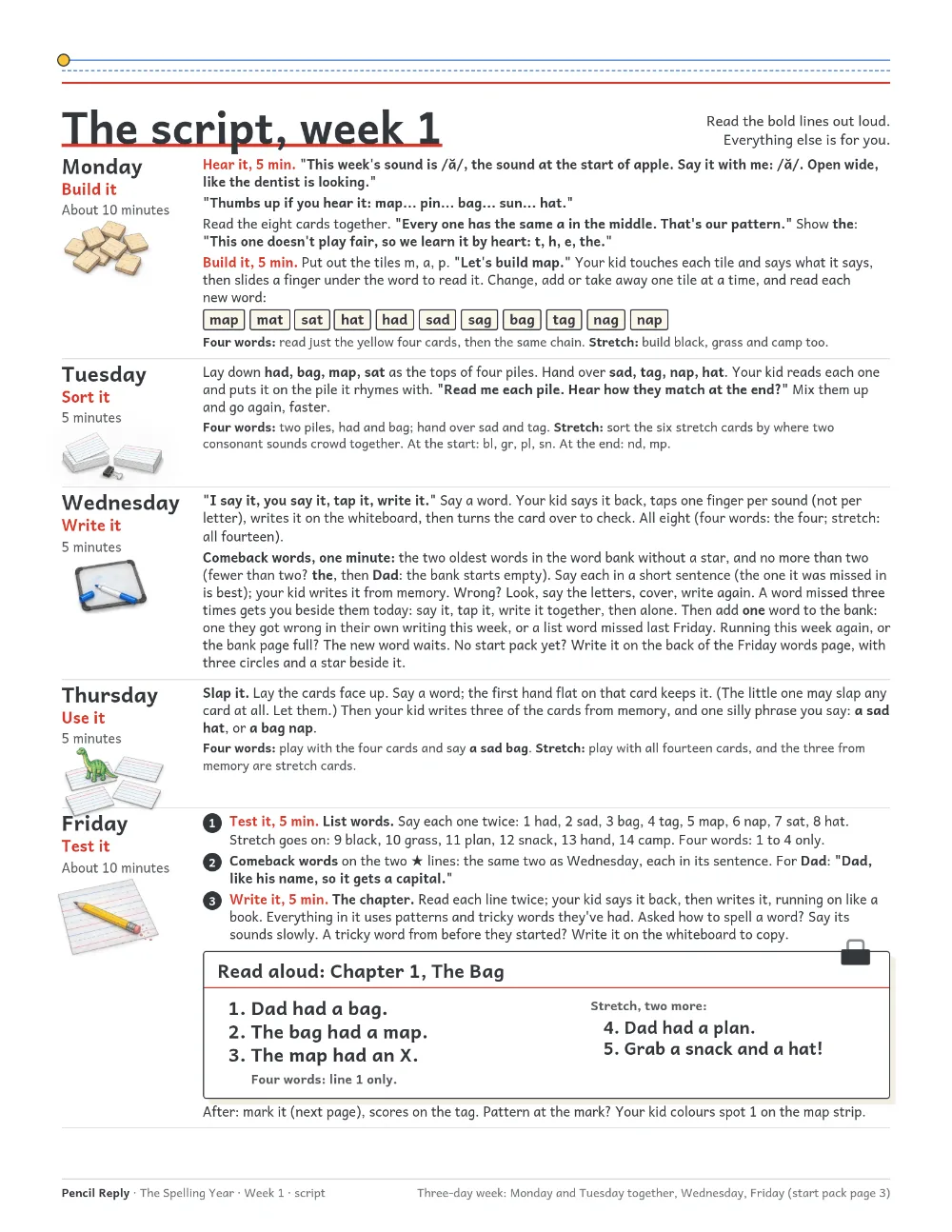
Week 1's script. Friday's dictation is Chapter 1. 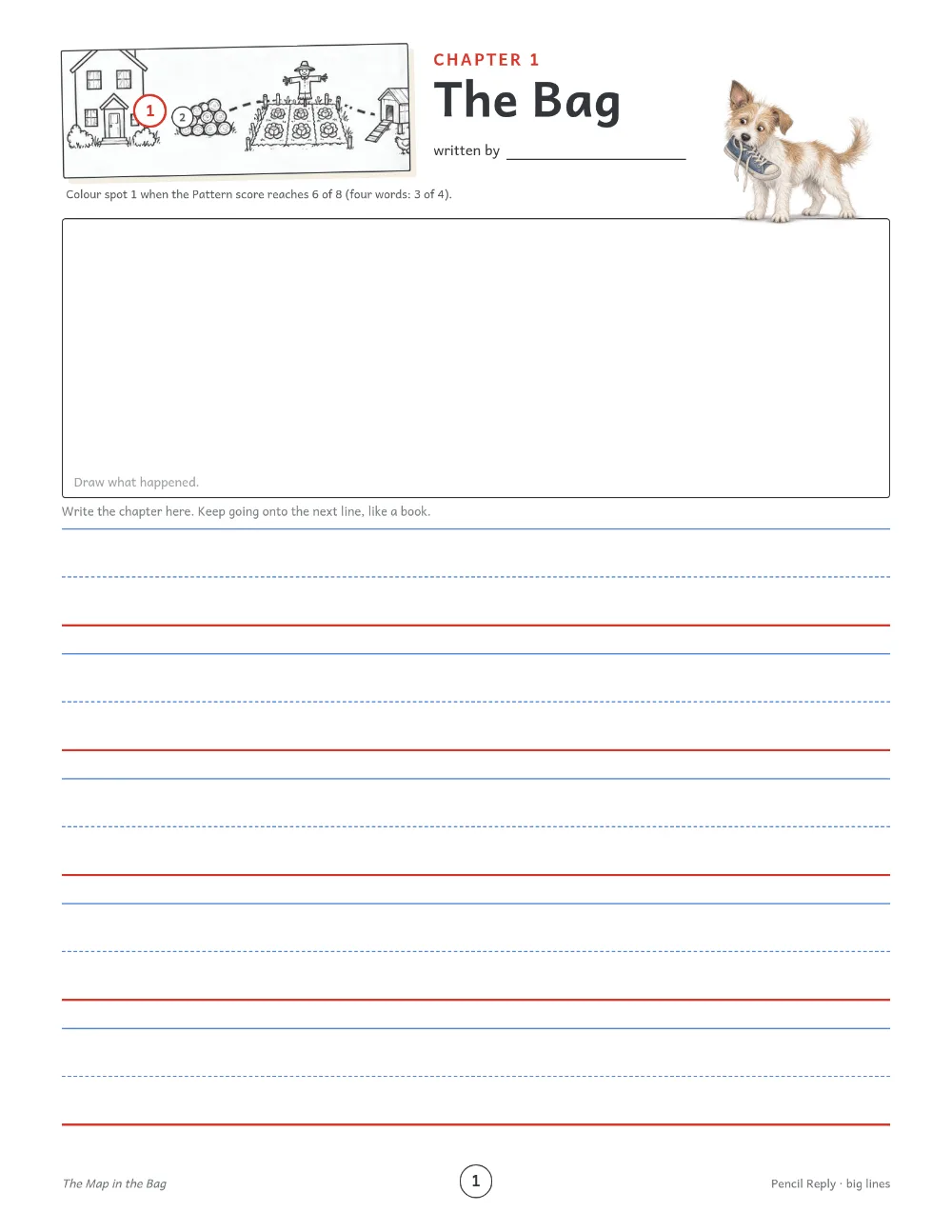
Week 1's chapter page. This one goes in the binder. 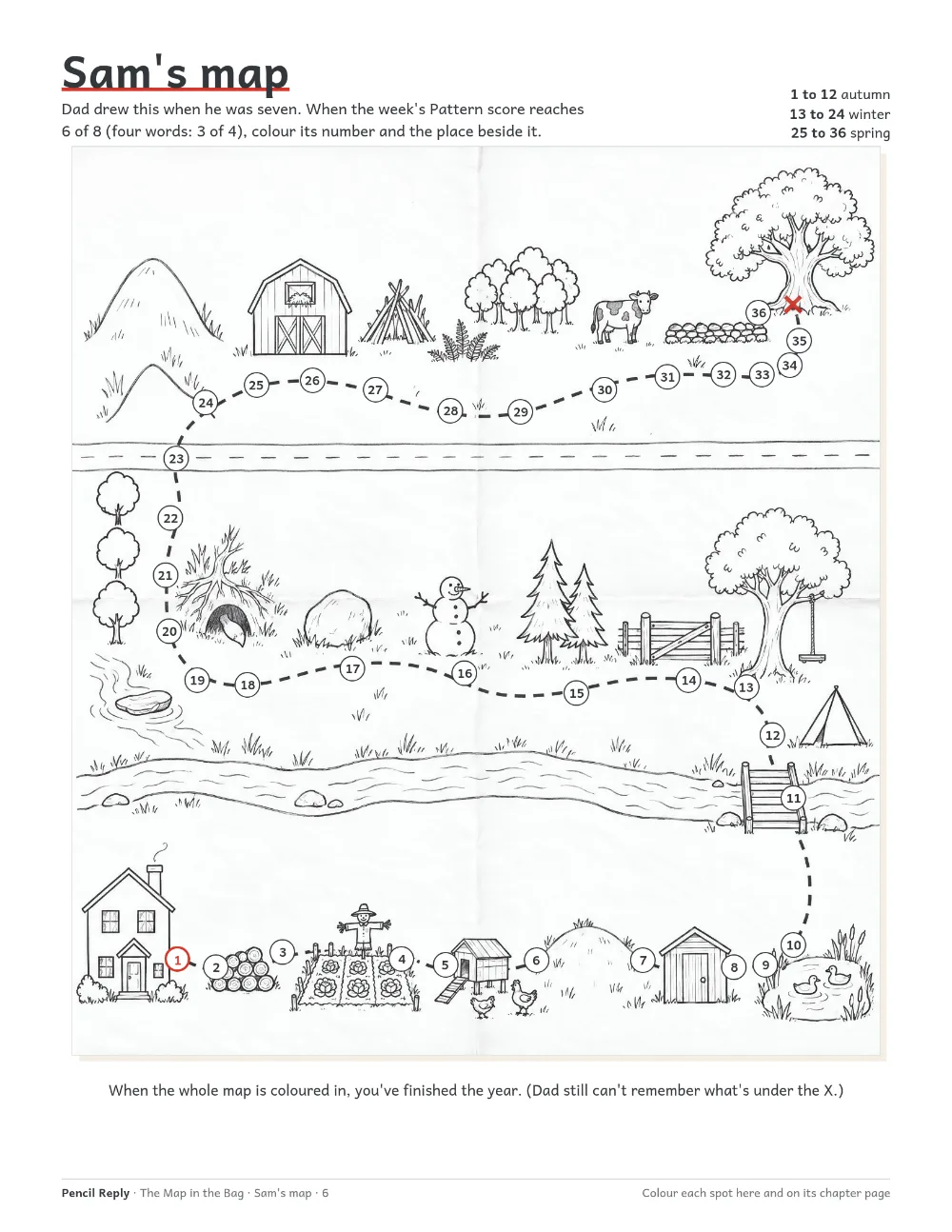
Sam's map. One spot a week, coloured when the Pattern score reaches 6 of 8 (four words: 3 of 4). 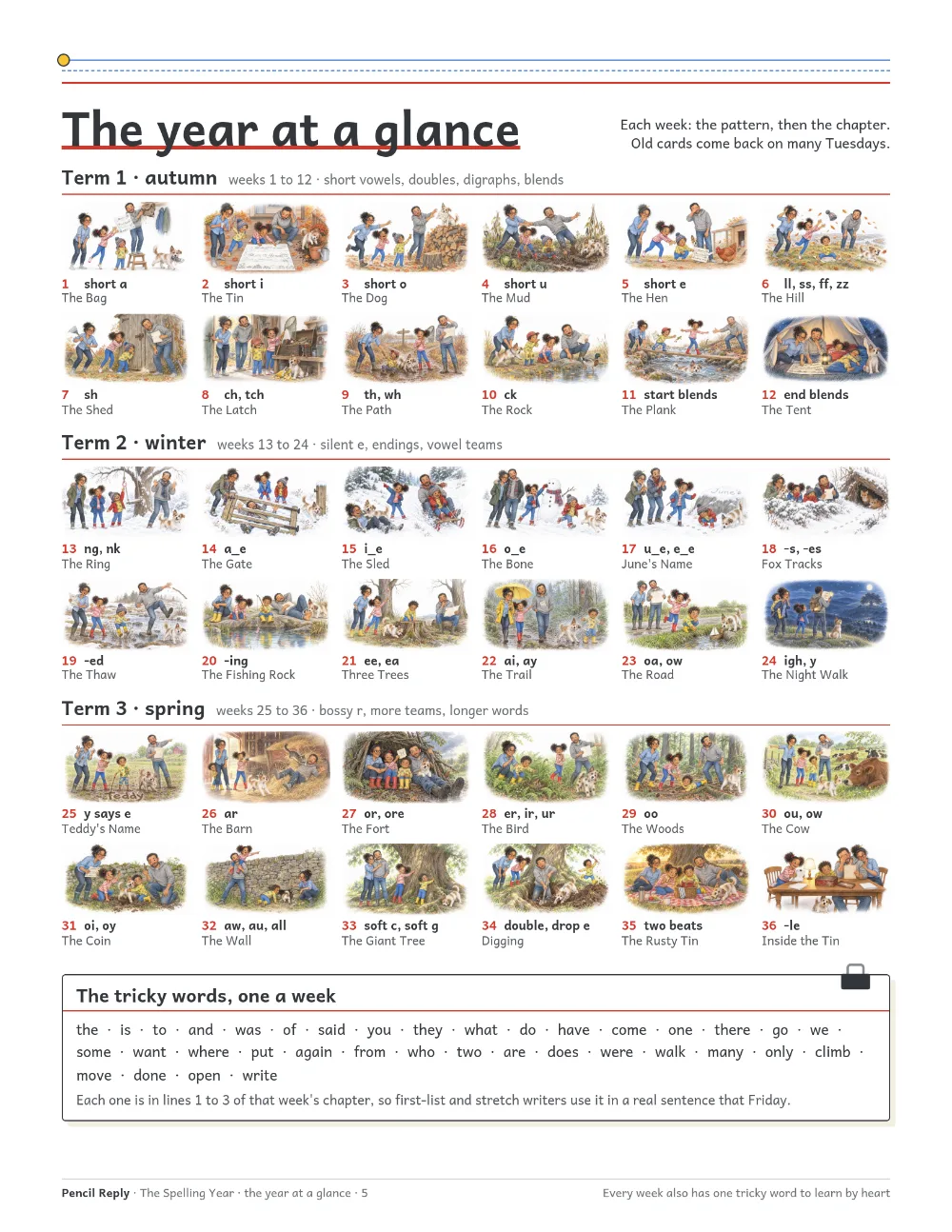
The year at a glance: 36 weeks, 36 pictures, 36 tricky words.
Why it works at a kitchen table
Friday is a story chapter your kid wants to write. The test lines are the next part of the family's treasure hunt, and when the week's Pattern score reaches the mark (6 of 8, or 3 of 4 on four words) they colour a spot on Sam's map. Started at week 1, the 36 chapter pages become their own book, with its cover and last page. On a four-word week they write line 1 and you write the rest while they watch. Starting later? Their book starts at their first chapter.
It's scripted, so you always know what to say, and there's nothing else to buy. Letter tiles, letter teams each with its sound and an example word, word cards and the placement check are in the files.
Your kid's own misspelled words come back on Wednesday and Friday through the word bank, so the list isn't the only thing they practise.
One page tells you what went wrong and what to do next: three plain scores, the week's usual slips with a fix for each, a three-minute Monday retest when it isn't clicking, then four words. Too easy? There's the stretch list.
Kindergarten to 2nd grade, and older kids who are catching up, from the same week. A first list and big lines for the younger kid, a stretch list and regular lines for the 2nd grader or an older kid catching up, and a page for the little one who wants a test too.
What you need
- A PDF reader and a home printer. Black and white works; colour is nicer for the art and the red and blue lines.
- US Letter paper printed at Actual size, or A4 printed with Fit. Card stock is nice for the letter tiles, but plain paper works.
- Scissors for the word cards and tiles, a pencil and an eraser. A binder or folder for your kid's chapter pages. Binder clips and a lap whiteboard help, and scrap paper works instead.
What it isn't
- No videos, app, online games or audio. It's a printable plan you read aloud.
- No physical letter tiles or cards. You print and cut them.
- Not written for a 3rd grader or older who already spells at grade level. The patterns run from short vowels to early 2nd grade spelling, so most of it would be review.
- Spelling only. Reading, handwriting and grammar lessons aren't in it.
The Spelling Year
$29 once for all 36 weeks and the start pack. One term alone is $12, with the start pack.
The year isn't on sale yet. When it opens it's $29 once, or $12 a term. Until then, week 1 is free, and the free series will tell you the day it opens.